
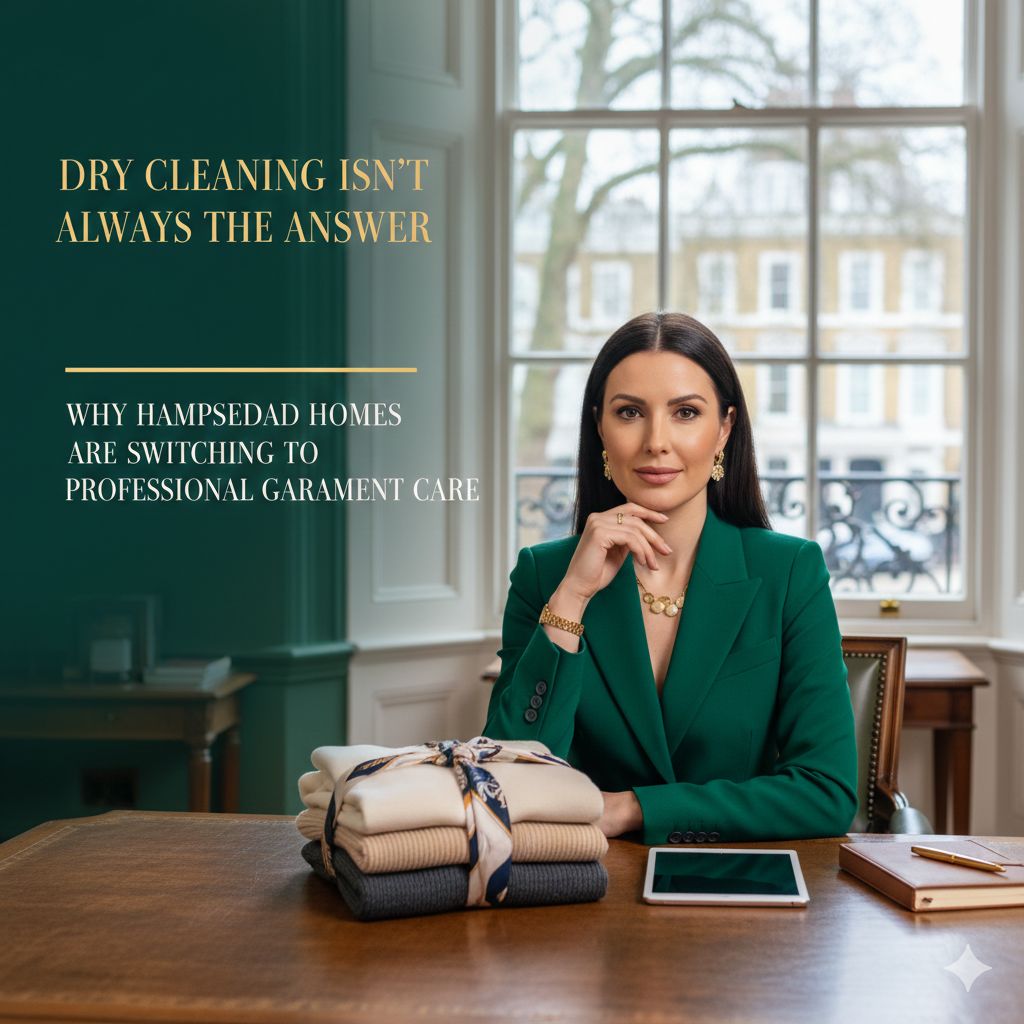
Dry Cleaning Isn’t Always the Answer
Why Hampstead Homes Are Switching to Professional Garment Care
Professional Garment Care vs Dry Cleaning is no longer just a preference question in Hampstead—it’s a wardrobe-protection decision.
For decades, dry cleaning has been the gold standard of garment maintenance in London. The phrase itself carries authority—professional, safe, suitable for expensive or delicate clothing. In Hampstead homes, dry cleaning became the default choice for suits, coats, dresses, and other luxury items considered too valuable for home washing.
But here is the commercial reality many households are now confronting: dry cleaning cleans garments, but it does not necessarily protect them.
Modern wardrobes are more complex than ever. Fabrics are engineered with blends, interlinings, stretch fibres, and layered construction. Add London’s environmental pressures—humidity, pollution, frequent wear—and garments face continuous stress long after they leave the cleaner.
This is where professional garment care changes the equation.
Professional garment care is not about making clothes look acceptable for the next wear. It is about extending garment lifespan, preserving structure, and protecting the financial value of a wardrobe.
That is why Hampstead families are actively moving away from routine dry cleaning and choosing professional garment care as a long‑term solution.
This article explains why that shift is happening—and why it makes financial and practical sense.
👉 If you already know your clothes deserve better care, you can book a professional garment care collection in Hampstead now, or message our team on WhatsApp for immediate advice.
Why Dry Cleaning Became the Default in London
 Dry cleaning rose to prominence in London because it solved a visible problem at exactly the right historical moment. As wardrobes became more tailored and urban lifestyles accelerated, households needed a way to keep garments looking respectable without the risks associated with water washing.
Dry cleaning offered three powerful advantages:
- It removed surface stains without water contact
- It reduced the risk of shrinkage in wool and tailored garments
- It returned clothing pressed, structured, and immediately wearable
For busy London households, especially in areas like Hampstead where professional dress and formalwear were common, this combination felt like technical expertise rather than simple convenience.
There was also a psychological factor at play. Dry cleaning separated care from the home. Garments were taken to specialists, handled by machines and processes most people didn’t understand, and returned looking improved. That distance created trust.
And visually, dry cleaning delivers. Clothes come back crisp, odour-free, and polished. Creases are sharp. Fabrics look refreshed. For decades, this immediate transformation was accepted as evidence that garments were being properly cared for.
But visual improvement is not the same as textile health.
Dry cleaning was designed to solve short-term appearance issues, not to manage long-term fibre stability, internal structure, or cumulative wear. As long as garments looked fine, the underlying effects on fibres, interlinings, and finishes went unquestioned.
What dry cleaning excels at—short-term surface cleanliness—it often neglects in long-term fabric preservation.
This is usually the moment clients decide to stop guessing and book professional garment care instead of repeating another dry-cleaning cycle.
The Hidden Limits of Dry Cleaning for Modern Garments
For Hampstead households investing in quality clothing, understanding these limits is essential—because repeated dry cleaning can quietly reduce garment value without any obvious warning signs.
Many clients only notice the damage after several seasons, when a coat no longer holds its shape, a jacket feels lifeless, or a garment that once felt luxurious suddenly looks tired. By that stage, the damage has already been done.
Solvent-Focused, Not Fabric-Focused
Traditional dry cleaning relies on solvents that dissolve oils and stains. These solvents follow a standardised process, applied broadly across garment types, regardless of construction or long-term wear expectations.
Repeated solvent exposure can:
- Weaken natural fibres at a molecular level
- Strip protective finishes designed to maintain softness and resilience
- Alter texture, drape, and surface feel
- Reduce elasticity and recovery
- Shorten garment’s lifespan significantly
This impact is amplified in modern luxury clothing that combines wool, silk, cotton, or cashmere with synthetics, fusible interlinings, stretch panels, or internal bonding.
The garment may appear clean, but internally it is ageing faster than it should.
Clean Doesn’t Always Mean Stable
Dry cleaning focuses on visible cleanliness. It does not always protect the components that give a garment its structure and performance.
Over time, garments repeatedly dry-cleaned may suffer from:
- Gradual shape distortion
- Fibre fatigue and thinning
- Odours return quickly after wear
- Loss of softness, flexibility, or natural movement
These outcomes are often misattributed to “normal wear.”
In reality, they are care failures caused by repeatedly using the wrong process.
If you recognise these signs in your wardrobe, the safest next step is to book a professional garment care collection or contact our team on WhatsApp before further damage occurs.
What Professional Garment Care Actually Means
 This is where the difference between cleaning and care becomes commercially important.
Professional garment care is not a single process. It is a decision framework designed to protect garments over the years, not just prepare them for the next wear.
Fabric-First Assessment
Each garment is evaluated individually based on:
- Fibre composition and blend ratios
- Construction and tailoring methods
- Stress and wear patterns
- Intended lifespan and usage frequency
Instead of forcing garments into a standard system, the treatment method is selected based on the garment’s requirements.
This alone prevents significant cumulative damage.
Structure-Aware Treatment
Professional garment care recognises that garments are engineered objects.
Treatment decisions account for:
- Interlinings and bonding
- Seam tension and stitch density
- Stress points such as shoulders, cuffs, and waistlines
- Weight distribution across panels
By respecting structure, professional garment care prevents the slow internal breakdown that often occurs with repeated solvent-only cleaning.
Longevity Over Speed
Professional garment care prioritises longevity because longevity saves money.
Instead of focusing on next‑day turnaround at any cost, the objective is:
- Preserving original fit and silhouette
- Maintaining colour depth and surface finish
- Preventing fibre fatigue and brittleness
- Extending usable garment life
For Hampstead families, this approach reduces replacement frequency, protects tailoring investment, and keeps wardrobes performing year after year.
This shift—from speed to preservation—is exactly why expectations in Hampstead homes are changing.
Most Hampstead clients reach this point and choose to book professional garment care rather than risk another standard dry-cleaning cycle.
Why Hampstead Homes Needs a Different Approach
Hampstead wardrobes represent both financial and emotional investment. Treating them with routine dry cleaning alone is no longer sufficient.
Unlike fast-fashion households, Hampstead families typically build wardrobes around quality, fit, and longevity.
Common characteristics include:
- Higher individual garment value
- Seasonal rotation rather than frequent disposal
- Investment pieces worn over many years
- Alterations and tailoring to maintain fit
In this context, garment care becomes a maintenance strategy—not a cleaning transaction.
Professional garment care aligns with how Hampstead families actually use their clothing: carefully, repeatedly, and over the long term.
This is why professional garment care in Hampstead is not a luxury add‑on—it is a cost‑control strategy that protects the value of the wardrobe over time.
When Dry Cleaning Still Makes Sense—and When It Doesn’t
 When Dry Cleaning Is Appropriate
Dry cleaning remains useful for:
- Targeted stain removal
- Certain structured formal garments
- Occasional treatments where solvents are necessary
When It Becomes a Risk
Dry cleaning becomes problematic when used repeatedly on:
- Knitwear
- Blended luxury fabrics
- Garments with an internal structure
- Clothing exposed to frequent wear
Using the wrong process too often creates invisible deterioration—until the damage becomes irreversible.
Choosing Garment Care Over Replacing Clothes
For many households, clothing replacement happens gradually—and unnoticed.
A coat that no longer sits correctly is replaced. A knit that has lost softness is retired. A jacket that looks tired is phased out.
The common assumption is that garments simply wear out.
The Hidden Cost of Replacement
In reality, many garments fail early due to cumulative care damage rather than age.
When garments are replaced prematurely, the financial loss far exceeds the cost of proper professional garment care.
Professional garment care protects:
- Fabric integrity and resilience
- Fit, tailoring, and silhouette
- Long-term wardrobe value
For Hampstead households, choosing garment care over routine dry cleaning is a rational financial decision—not indulgence.
This is exactly why many clients stop researching at this point and proceed directly to booking professional garment care.
Clothing Isn’t Disposable in Hampstead Homes
 Replacing garments prematurely is one of the most expensive wardrobe habits London households develop—often without realising it.
In Hampstead and North London, clothing represents investment, identity, and continuity.
Professional garment care preserves structure, fabric, and value—offering a smarter alternative to routine dry cleaning.
For Hampstead households, the decision is clear: care garments properly, or replace them sooner than necessary.
Book a Professional Garment Care Collection in Hampstead
Schedule your collection online in under a minute.
Speak to Our Garment Care Team on WhatsApp
If you have questions or concerns about specific garments or would like reassurance before ordering, our team is available to advise you directly.
Internal Reading
- Home Washing Damages Clothes
- Why Home Laundry Is Costing Hampstead Families More Than Professional Cleaning
Category: Luxury Garment Care – Hampstead Homes



No comment