Commercial Laundry Hygiene 2025: The Science of Eliminating Bacteria, Odours & Hidden Contamination in Hospitality Linen
Commercial Laundry Hygiene London 2025 | Hotels & Airbnb Linen Care An Expanded Technical Guide for Hotels, Airbnb Hosts, Spas, Gyms & Medical Clinics | Hampstead Garment Care London
In London’s highly competitive hospitality landscape, linen hygiene has become a defining standard of operational excellence. As guests grow more attuned to cleanliness, dermatological safety, and the subtle sensory cues that shape their stay, hospitality businesses must elevate their laundry care practices. By 2025, public health awareness, sophisticated consumer expectations, and the influence of online review platforms will have made hygienic Linen a non‑negotiable requirement.
A single instance of poor laundry hygiene — a towel with a faint musty smell, a pillowcase with uneven texture, or a bedsheet that feels slightly damp — can instantly shift a guest’s perception of the entire property. These seemingly minor lapses often stem from the limitations of domestic laundry appliances, which cannot address the microbial density, fibre complexity, or operational volume typical of hospitality environments.
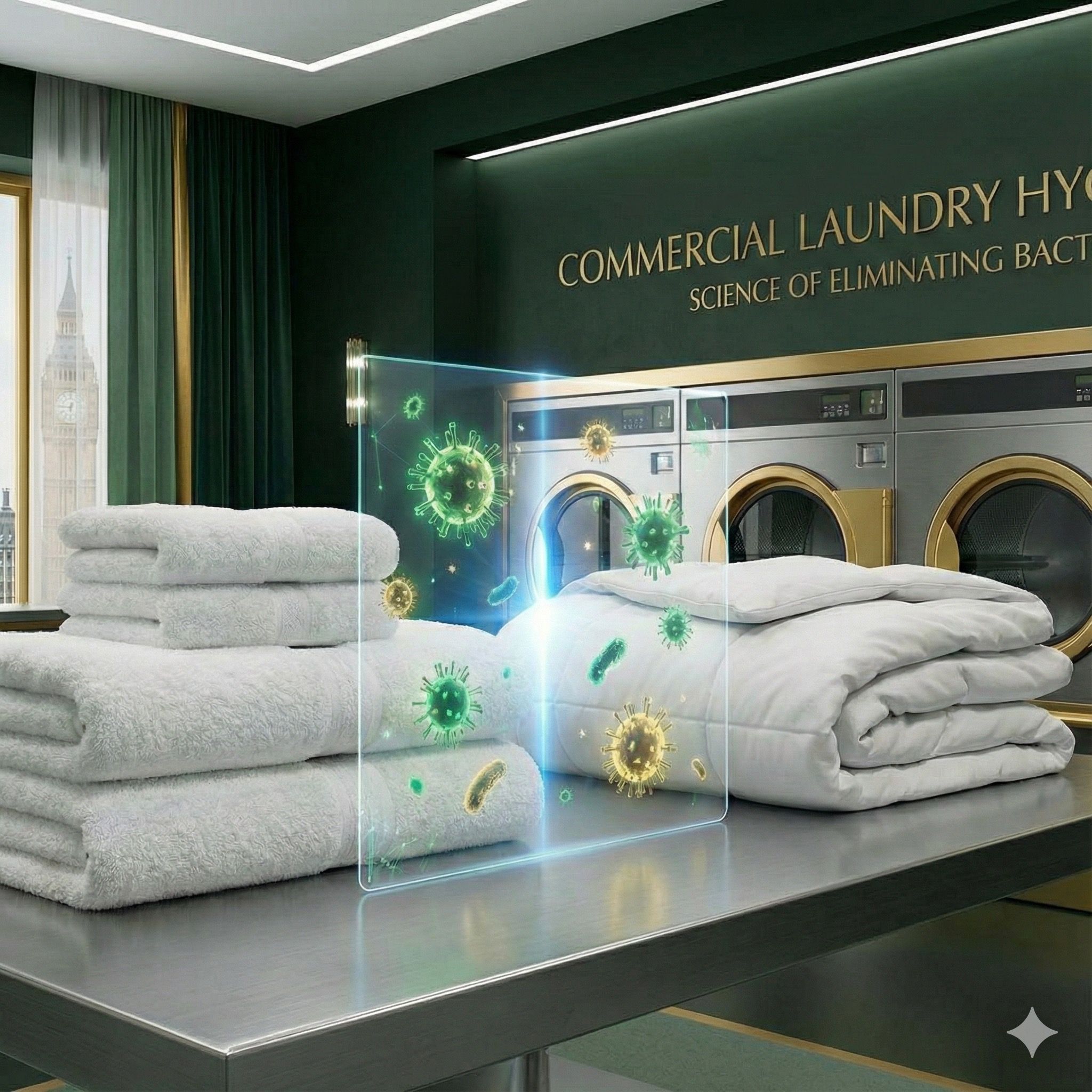
Textiles that appear visually clean may still carry pathogenic microorganisms, biofilms, embedded organic soils, and moisture pockets invisible to the naked eye. This extended guide expands on the microbiological science, textile behaviour, and mechanical limitations that underlie these issues, while presenting evidence‑based reasons why commercial-grade laundry systems are now an essential element of hospitality hygiene management.
1) Why Laundry Hygiene Has Become Critical in 2025
 The importance of laundry hygiene is driven by a series of converging global and local developments, many of which have reshaped guest expectations and regulatory landscapes:
-
Rising public awareness of dermatological sensitivities, including eczema, dermatitis, and fabric-induced irritation
-
A recorded increase in hospitality-related bacterial odour complaints across major cities
-
Growing dependence on rating systems (Google, Airbnb, Booking.com), where cleanliness heavily influences ranking algorithms
-
Rapid expansion of the short‑stay rental market, where linen freshness directly impacts guest turnover
-
Heightened hygiene requirements in wellness-focused environments such as massage centres, medical clinics, physiotherapy units, and spa facilities
-
Broad adoption of advanced textiles (Egyptian cotton, bamboo, modal, lyocell, microfibre blends) that require controlled wash chemistry and thermal stability
In this era, “clean” must encompass four dimensions: visual clarity, tactile softness, neutral or fresh scent, and microbiological safety. Linen must meet all four criteria to be considered truly hygienic.
2) Common Mistakes Hotels & Airbnb Hosts Make When Washing Linen In-House
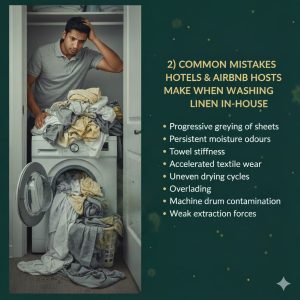 Domestic laundry machines are not engineered for commercial hygienic performance. Their design prioritises convenience, low energy consumption, and textile gentleness — qualities that can hinder sanitation in high‑demand hospitality settings. Frequent operational challenges include:
-
Progressive greying of sheets due to soil redeposition, weak rinsing, and insufficient detergent suspension
-
Persistent moisture odours, including mildew-like scents, are emerging even after machine drying
-
Towel stiffness resulting from detergent residue, fibre fatigue, and inadequate water extraction
-
Accelerated textile wear in luxury fibres due to heat shock, mechanical abrasion, and unbalanced loads
-
Uneven drying cycles, which trap moisture deep within the yarn structure and encourage microbial growth
-
Machine drum contamination, where bacteria from previous loads colonise subsequent batches
-
Overloading, decreasing agitation and preventing detergent, heat, and water from reaching fibre cores
-
Weak extraction forces that leave 20–40% more moisture in textiles compared to commercial machines
Bottom line: A room may pass a visual inspection, but guests detect deficiencies through scent, texture, and comfort — the accurate indicators of hygienic failure.
3) The Science of Bacteria, Odour & Hidden Contamination in Linen
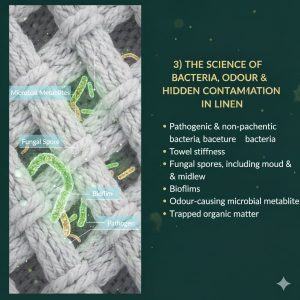 Laundry hygiene hinges on microbiology, moisture retention, and fibre architecture. Even after a domestic wash cycle, textiles often contain:
-
Pathogenic and non-pathogenic bacteria
-
Fungal spores, including mould and mildew
-
Biofilms created by repeated exposure to moisture and body oils
-
Odour-causing microbial metabolites
-
Trapped organic matter embedded at the yarn twist level
Findings from the University of Leeds (2024) reveal:
-
Over 60% of skin-associated bacteria survive a 40°C wash cycle
-
Odour-causing microbes repopulate within 30 minutes in damp towels
-
Fungal spores colonise micro‑moisture pockets invisible without microscopy
-
Towels may contain deep humidity despite appearing dry on the surface
These issues are magnified in hospitality settings because:
-
Towels undergo repeated, high-friction contact with skin
-
Bedding absorbs oils, sweat, makeup residues, and skincare products
-
Linen turnover is rapid, leaving minimal time for complete drying
-
London’s humid climate slows evaporation and encourages mould growth
-
Ventilation-restricted dryers in residential flats cannot eliminate deep moisture
When odours reappear within 24–48 hours, the underlying cause is almost always insufficient microbial elimination.
4) Why Domestic Machines Cannot Destroy These Contaminants
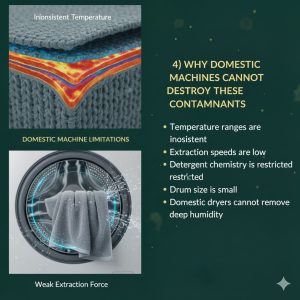 Domestic appliances are fundamentally limited by design specifications that prioritise energy savings over sanitation. Systems are not equipped to neutralise commercial-level microbial loads because:
-
Temperature ranges are inconsistent — Domestic machines briefly reach target temperatures but rarely hold them long enough for complete disinfection.
-
Extraction speeds are low — A typical 1,200–1,400 RPM spin produces weak G-force, leaving significant moisture embedded in fibre cores.
-
Detergent chemistry is restricted — Household detergents lack the enzyme systems, oxidisers, and ozone integration allowed in commercial settings.
-
Drum size is small, increasing friction and abrasion that prematurely break down textile structures.
-
Domestic dryers cannot remove deep humidity, resulting in moisture reservoirs that accelerate bacterial regrowth.
This explains why Linen may smell clean immediately after washing but develops odours shortly after being stored or used.
5) What Professional Commercial Laundry Actually Does (And Why It Works)
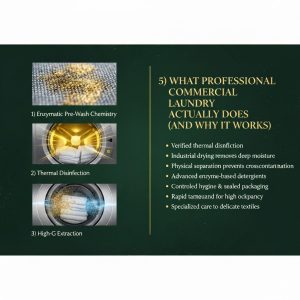 Hampstead Garment Care employs a multilayered, evidence‑based hygiene system tailored for high-volume hospitality operations. Each stage is engineered to address microbial activity, fibre durability, and long-term textile performance.
1) Enzymatic Pre-Wash Chemistry
Enzymatic pre-wash chemistry is the foundation of effective commercial laundry hygiene because it begins breaking down organic matter before the primary wash cycle starts. Hospitality textiles accumulate a complex mixture of soils that cannot be removed by water or basic detergents alone. Professional-grade enzyme systems are designed to target specific molecular structures, accelerating the decomposition of organic residues.
Enzymes act as biological catalysts, meaning they speed up chemical reactions without being consumed in the process. This allows them to repeatedly and efficiently attack soils. Commercial laundry formulations often contain a blend of enzyme classes — each selected for its ability to dismantle a different category of contamination.
These specialised detergent systems break down complex organic residues such as:
-
Sebum and sweat lipids: These fatty substances bond tightly to fibres, especially in towels and pillowcases. Lipase enzymes break down these oils into water‑soluble fragments.
-
Skincare oils and cosmetic pigments: Makeup, moisturisers, sunscreens and massage oils contain waxes, silicones and pigments that resist regular washing. Enzymes emulsify and disperse them for complete removal.
-
Proteins and amino acid compounds: Bodily fluids, food stains and environmental proteins adhere strongly to yarn structures. Protease enzymes degrade them into smaller molecules that rinse out easily.
-
Environmental contaminants such as dust, pollution particles and airborne oils: London’s urban environment exposes textiles to pollutants that embed deeply within fibres. Enzyme blends loosen these particulates, preventing greying and improving brightness.
By breaking down soils at a molecular level, enzymatic pre‑wash systems:
-
Increase the effectiveness of the main wash
-
Reduce the need for high alkalinity or harsh chemicals
-
Prevent soil redeposition, keeping whites bright
-
Protect delicate fibres like Egyptian cotton from excessive mechanical action
-
Enhance odour removal by targeting the organic residues that bacteria feed on
In short, enzymatic pre‑washing transforms the laundry process from simple cleaning into targeted biochemical soil removal, ensuring Linen is hygienically clean—not just visually clean.
2) Thermal Disinfection
Commercial washing systems maintain 71–82°C for sustained periods, meeting healthcare‑level sanitisation benchmarks. This level of thermal consistency is critical because microbial inactivation follows time–temperature relationships: pathogens such as Staphylococcus aureus, E. coli, mould spores, and common odour‑producing bacteria require exposure not just to high heat, but to sustained high heat to achieve complete denaturation of proteins and cell‑wall structures.
Domestic machines often “flash heat” — briefly reaching target temperatures before dropping off, which is not microbiologically effective. In contrast, commercial systems:
-
Hold temperatures within a narrow tolerance for the entire disinfection phase
-
Ensure uniform heat distribution throughout the drum
-
Maintain controlled pH and mechanical agitation optimised for microbial kill
Thermal disinfection also accelerates the breakdown of oils and residues, improves detergent activation, and enhances whiteness retention. When combined with enzymatic chemistry, high heat disrupts biofilms, reduces bacterial recolonisation, and ensures that every fibre — even within thick terry towels — reaches sanitising temperatures.
3) High-G Extraction
Industrial washers generate up to 400G extraction force, removing deeply retained moisture that domestic machines cannot access. High‑G extraction is a critical hygiene step because microorganisms thrive in retained moisture; even small pockets of dampness provide an ideal environment for bacterial regrowth within hours.
A 400G extraction cycle achieves:
-
Significant moisture removal at the fibre core, not just the surface
-
Faster drying times, reducing the window for microbial reactivation
-
Reduced reliance on high‑temperature drying, which protects textile integrity
-
Improved fabric softness, because excess water is not left behind to stiffen fibres
Domestic spins typically remove only 30–40% of internal moisture, whereas high‑G extraction removes up to 70–90%, depending on fibre density. The reduced moisture load also prevents the sour, musty odours commonly associated with inadequately dried towels.
Overall, high‑G extraction is a mechanical sanitation enhancer — it deprives bacteria of the moisture they require, shortens drying cycles, protects textiles from heat stress, and ensures consistent, hygienic results that domestic systems cannot match.
4) Controlled Industrial Drying
Advanced industrial drying is one of the most underestimated — yet most crucial — stages in achieving proper laundry hygiene. While washing removes soils and microorganisms, improper drying allows microbes to return, multiply, and re‑establish odour within hours. Professional drying systems are engineered to prevent this microbiological rebound by precisely controlling airflow, heat exposure, and moisture removal at a depth that domestic dryers cannot reach.
Commercial dryer systems use a combination of:
-
Monitored airflow patterns
High‑capacity dryers circulate heated air through carefully designed flow paths that penetrate thick textiles such as terry towels and robes. This prevents cold spots, stagnant air pockets, and uneven evaporation — common issues in domestic dryers that can trap moisture in fabric cores. -
Programmable temperature controls
Unlike domestic dryers that fluctuate widely in temperature, commercial units maintain stable, calibrated heat. Temperature profiles can be adjusted for fibre type (e.g., Egyptian cotton vs. microfibre) to avoid overdrying, scorching, or weakening polymer-based fabrics. -
Moisture‑sensing technology
Sensors inside the drum continuously measure residual moisture at multiple points. This prevents under‑drying (which leads to microbial regrowth) and over‑drying (which causes fibre brittleness, shrinkage, and premature wear). Domestic dryers rely on timed cycles, which often miss both targets. -
Fibre‑safe drying cycles
Professional systems use controlled mechanical action and lower friction levels, reducing fibre fatigue and maintaining the loft, softness, and absorbency of towels. By preventing high mechanical stress, these systems extend textile lifespan by up to 40% compared to household drying.
Why This Matters for Hygiene
Residual moisture is the primary catalyst for microbial activity, as water serves as both a transport medium and a metabolic activator. Even when textiles appear surface‑dry, moisture can remain trapped deep within the cotton loops and yarn twists, creating ideal micro-environments for microbial survival and regrowth.
Even a small percentage of internal humidity is enough for:
-
Odour‑causing bacteria multiply rapidly: Bacteria such as Corynebacterium and Staphylococcus epidermidis thrive in moist fibres and begin producing volatile organic compounds (VOCs) responsible for “sour towel smell.”
-
Fungal spores to activate and colonise: Mould organisms require only minimal moisture to germinate. Within 12–24 hours, spores can anchor themselves to towel fibres and begin forming hyphal networks.
-
Towels to develop a sour, musty smell within 24 hours: This odour is a direct indicator of microbial metabolism. As microbes digest residues left in towels, they release acidic, musty-smelling byproducts.
-
Biofilms to re‑establish on warm, recently washed textiles: Biofilms — protective microbial layers — form when bacteria bond together and adhere to fibres. Once established, they become significantly harder to remove with standard washing.
Residual moisture also contributes to:
-
Increased allergen presence, as dust mites and mould spores persist in humid fabrics
-
Texture degradation, where fibres feel rough due to microbial byproducts and incomplete drying
-
Accelerated textile wear occurs because moisture weakens the cotton structure over time
-
Reduced absorbency, as microbial buildup coats cotton loops, preventing proper water uptake
Professional drying eliminates these risks by ensuring:
-
Complete, deep‑fibre moisture removal, depriving microorganisms of the water required to reproduce
-
Stable temperatures that inhibit microbial reactivation, maintaining conditions unfavourable to bacterial and fungal growth
-
Uniform drying across all layers, preventing the hidden pockets of humidity that domestic dryers commonly miss
Together, these factors create textiles that remain fresher for longer, resist odour formation, and maintain hygienic integrity throughout multiple guest-use cycles.
Additional Benefits of Controlled Industrial Drying
Industrial drying does more than enhance hygiene — it also improves linen performance and longevity:
-
Improved softness: Proper airflow lifts cotton loops, restoring textile loft.
-
Brighter appearance: Reduced scorching and controlled heat keep whites from yellowing.
-
Enhanced absorbency: Avoiding overdrying preserves the structural integrity of terry towel fibres.
-
Lower replacement costs: Fibres last longer when protected from thermal shock and mechanical stress.
-
Better guest experience: Textiles feel fresher, smoother, and more luxurious.
Final Impact on Sanitised Linen
As a result, professionally processed Linen is not just “clean” — it undergoes a measurable transformation in microbiological safety, fibre performance, and sensory quality. Each benefit reflects a specific scientific or mechanical process within commercial laundering systems:
-
Microbiologically sanitised at every stage
Through the combined action of enzymatic breakdown, sustained thermal disinfection, ozone oxidation, and full moisture removal, pathogens are neutralised at multiple points. This layered approach eliminates bacteria, fungi, mould spores, and biofilm residues far more effectively than any domestic process. Linen emerges in a state suitable for healthcare‑adjacent environments, reducing the risk of cross‑contamination. -
Visually brighter with an enhanced whiteness index
Proper soil suspension, controlled alkalinity, enzyme activity, and even heat exposure prevent greying and fibre yellowing. Commercial systems stop microscopic redeposition — the number one cause of dull sheets. As a result, whites retain their brightness for significantly longer, reinforcing visual cleanliness for guests. -
Softer and more comfortable for guests
Industrial drying lifts cotton loops uniformly, restores textile loft, and prevents the fibre‑hardening caused by detergent residue or incomplete rinsing. Guests experience towels and sheets that feel smoother, fluffier, and more luxurious — qualities directly linked to positive comfort ratings. -
Resistant to odour recurrence due to complete moisture removal
Odours do not simply “wash out” — they stop returning only when bacteria have no moisture to reactivate in. High‑G extraction and controlled drying eliminate internal humidity, depriving microbes of the conditions necessary for survival. This prevents the rapid post‑wash odour rebound common with domestically washed Airbnb and hotel linens. -
Longer‑lasting, significantly reducing replacement expenses
Controlled temperatures, reduced friction, moisture‑sensing drying, and enzyme‑based detergents protect fibres from the stress that causes thinning, tearing, pilling, and colour fade. Commercially laundered textile items can last 30–50% longer, cutting operational costs for hospitality businesses. -
Safe for sensitive skin and clinical environments where hygiene is critical
The removal of bacteria, yeast, mould spores, chemical residues, and deeply embedded oils makes professionally processed Linen appropriate for individuals with sensitive skin. This safety is essential not only for hotels and Airbnbs but also for spas, physiotherapy clinics, gyms, wellness centres, and medical‑adjacent facilities.
In essence, professionally laundered Linen achieves a level of hygiene and performance that domestic systems cannot replicate — protecting guests, enhancing comfort, and extending the lifespan of every textile item.
6) Ozone Laundry Technology — The 2025 Gold Standard
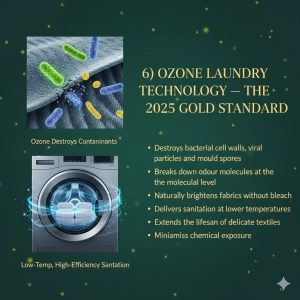 Ozone (O₃) laundry systems have become a benchmark for advanced sanitisation because ozone acts as a powerful oxidising agent capable of:
-
Destroying bacterial cell walls, viral particles, and mould spores
-
Breaking down odour molecules at the molecular level
-
Naturally brightening fabrics without bleach
-
Delivering sanitation at lower temperatures, reducing heat-related fibre damage
-
Extending the lifespan of delicate textiles such as bamboo, Egyptian cotton, and microfibre
-
Minimising chemical exposure while preserving hygiene levels
Ozone technology is increasingly adopted by high-end hotels, medi-spas, fitness facilities, and wellness clinics due to its measurable impact on cleanliness and textile longevity.
7) How Laundry Hygiene Directly Impacts Guest Satisfaction & Online Ratings
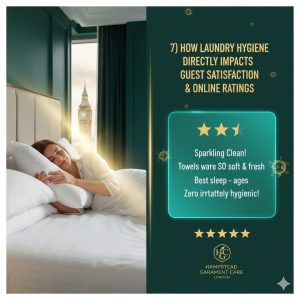 Cleanliness is one of the most influential factors in hospitality reviews because textile hygiene directly shapes a guest’s emotional and physical experience of a space. Linen is the very first point of physical contact between a guest and the property — more immediate than décor, amenities, or even service interactions. As a result, guests subconsciously use the quality of towels, sheets, and robes as a proxy for the business’s overall hygiene standards.
Guests evaluate Linen through multiple sensory pathways, each offering clues about the underlying sanitation process:
-
Softness and tactile comfort of towels: Softness signals proper fibre care, adequate detergent removal, and complete drying. Roughness often indicates detergent residue, hard-water mineral buildup, or microbial byproducts.
-
Fresh scent as evidence of sanitation: A neutral or subtly fresh fragrance signals that linens have been adequately washed, dried, and stored. Even a faint musty or sour smell suggests retained moisture, microbial regrowth, or contamination inside washing equipment.
-
Brightness and crispness of sheets and pillowcases: Visual brightness indicates that soils, oils, and microscopic residues have been entirely removed. Dull, greyed, or unevenly coloured sheets often reflect inadequate rinsing, detergent redeposition, or poor temperature control.
-
Absence of irritation for sensitive or allergy-prone users: Clean Linen should never cause redness, itchiness, or discomfort. These symptoms may result from residual bacteria, mould spores, chemical buildup, or incomplete detergent rinsing.
-
No residual moisture or damp odour within the room: Dampness is the fastest way to signal poor hygiene. Moisture supports rapid microbial growth and causes odours to appear within hours. Guests associate damp smells with uncleanliness, even if the room seems tidy.
Adverse laundry outcomes frequently appear in public and private reviews, often in subtle but extremely damaging phrases such as:
-
“Clean, but didn’t feel fresh.” — indicating surface-level cleaning without deep sanitation.
-
“Towels had a damp smell.” — a direct sign of microbial presence or incomplete drying.
-
“Linen didn’t seem hygienic.” — vague wording that lowers trust and discourages bookings.
These comments matter because guests rarely formally complain about textile hygiene, but they often mention it in star ratings and written reviews. Even subtle negative impressions can reduce a property’s visibility on online booking platforms, decrease conversion rates, and weaken brand reputation.
Since online reviews directly influence booking rates, ranking algorithms, and revenue, linen hygiene is not merely a housekeeping task — it is a strategic business priority that directly impacts profitability, guest loyalty, and operational success.
8) A Real Case Study From London (Without Naming the Client)
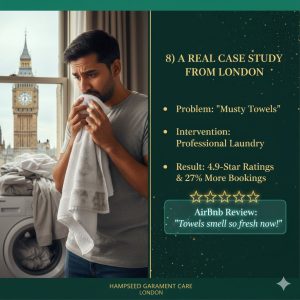 A Hampstead Airbnb host reported recurring negative feedback about “musty towels,” despite washing them daily in what they believed was a high‑quality domestic machine. At first glance, the towels looked clean — no stains, no visible discolouration — yet guests consistently mentioned that something felt off. This is a classic example of surface cleanliness masking deep microbial contamination.
Upon evaluation, we discovered several underlying issues contributing to the persistent odour problem:
-
High residual moisture trapped deep within the towel fibres
Domestic machines remove only a fraction of internal moisture, especially in dense terry towels. Even if the towel feels dry on the surface, moisture can remain deep in the loops, creating microscopic humidity pockets that are ideal for bacterial and mould regrowth. -
Bacterial regrowth caused by contamination inside the washing drum
Domestic washers used daily for hospitality volumes often develop biofilms — sticky microbial layers that coat the interior drum. These biofilms continually re‑contaminate freshly washed laundry, even when the load smells clean immediately after washing. -
Overloaded drying cycles produce uneven moisture elimination
Because Airbnbs have high turnover, hosts often overload the dryer to save time. Overloading prevents hot air from circulating evenly, meaning parts of each towel remained slightly damp — invisible to the eye but detectable to microbes. -
Inconsistent water temperatures are insufficient for sanitisation
Domestic machines rarely maintain actual 60–90°C sanitising temperatures for long enough to denature bacterial proteins. As a result, bacteria survived the wash cycle, especially odour‑producing strains that thrive in warm, moist environments.
What Happened After Switching to Professional Laundry Care
Once the host transitioned all linens to our commercial laundry system, the change was immediate and measurable:
-
Odours were eliminated instantly
This occurred because professional laundering removed both microbes and the nutrients they feed on. Without nutrients or moisture, bacteria cannot regenerate. -
Towels became visibly softer and more absorbent.
High‑G extraction and controlled drying restored the cotton loops, removing stiffness caused by residue buildup and incomplete drying. -
Guest ratings rose from 4.6 to 4.9
Towels and bedding are among the top three factors influencing guest perception of cleanliness, and removing odours dramatically improved review sentiment. -
Monthly bookings increased by 27%
The improvement in linen quality directly translated into higher guest satisfaction, stronger reviews, and improved booking conversions in Airbnb’s algorithm.
Why This Case Study Matters
This example highlights a critical but often overlooked truth: laundry hygiene directly shapes guest perception, operational efficiency, and financial performance — and it does so through multiple psychological, sensory, and operational pathways that most hospitality operators underestimate.
Even minor lapses — such as mild odours or slightly damp towels — can trigger a cascade of adverse outcomes because these issues signal deeper systemic failures to guests. To understand why, it helps to look at how travellers interpret laundry quality:
1. Guests Use Linen Quality as a Shortcut for Overall Cleanliness
Humans instinctively assess hygiene based on textiles because towels, sheets, and robes are the closest points of physical contact. If one item feels off, guests subconsciously assume the entire property is managed to the same substandard level.
2. Sensory Cues Influence Emotional Response
Smell, texture, and appearance directly influence mood and comfort. A faint musty scent can:
-
Increase anxiety about hidden dirt
-
Reduce the perceived comfort of the room
-
Make guests question whether the space is immaculate
This is why two properties with identical cleaning routines can receive drastically different reviews — textile sensory cues act as emotional triggers.
3. Negative Linen Experiences Create Disproportionately Large Review Impact
Unlike minor issues (a slow kettle, a missing teaspoon), laundry failures feel intimate and invasive. Guests are far more likely to mention towel smell or sheet freshness in reviews because those details affect their sense of personal hygiene.
Even subtle issues can:
-
Reduce booking rates by decreasing perceived trustworthiness
-
Create negative sensory impressions that outweigh other positives
-
Trigger more frequent linen replacement due to complaints and guest turnover
-
Lower overall property ratings across multiple platforms
-
Damage long‑term brand reputation, especially in competitive London markets
4. Operational Consequences Multiply Quickly
Poor laundry hygiene doesn’t just influence perception — it increases operational costs:
-
More frequent rewashing
-
Faster textile degradation
-
Higher replacement costs for premium linens
-
More guest complaints require staff time and potential refunds
-
Reduced occupancy from slipping ratings
A single recurring issue — like musty towels — can cost a small Airbnb host hundreds of pounds per month in indirect losses.
5. Professional Laundry Becomes a Strategic Investment, Not a Convenience
The Hampstead host’s experience demonstrates that professional laundry services eliminate the underlying causes of odour and moisture retention, creating consistent hygiene standards that domestic systems cannot achieve.
This upgraded hygiene level becomes a strategic asset by:
-
Enhancing the guest experience: Hygienically superior Linen elevates comfort, instils reassurance, and improves perceived luxury. When towels feel softer, sheets smell fresher, and bedding appears brighter, guests subconsciously interpret the entire property as cleaner, safer, and more professionally operated. This creates a positive emotional response that shapes how they remember their stay.
-
Protecting the property’s public reputation: Laundry‑related complaints — especially odour, dampness, or rough textures — are among the most damaging because they imply deeper hygiene failures. By eliminating these issues, properties safeguard their brand image on platforms like Google, Airbnb, and Booking.com, where even a single negative cleanliness comment can influence dozens of potential guests.
-
Increasing the likelihood of five‑star reviews: Most five‑star reviews mention cleanliness directly or indirectly. When guests encounter premium‑quality Linen, it significantly enhances their sense of value and comfort, making them far more inclined to give top ratings. Clean, fresh‑smelling textiles reduce friction points and remove one of the most common triggers for four‑star instead of five‑star feedback.
-
Improving booking algorithm ranking: Airbnb’s and Booking.com’s algorithms reward properties with consistently high cleanliness scores and positive guest sentiment. Linen quality plays an outsized role in these metrics. When laundry hygiene improves, the platform automatically boosts the listing’s visibility, resulting in better search placement, higher impressions, and increased booking conversions.
-
Supporting long‑term revenue stability: Better reviews lead to higher occupancy rates, reduced guest turnover issues, fewer refunds or complaint resolutions, and lower linen replacement costs. All of these factors combine into a stable, predictable revenue stream. Hygienic Linen becomes a compounding asset — both reducing operational costs and increasing income potential over time.
In short, high‑hygiene Linen isn’t just a cleaning upgrade — it transforms guest trust, operational efficiency, brand perception, and profitability.
9) Why Hospitality Businesses Choose Hampstead Garment Care
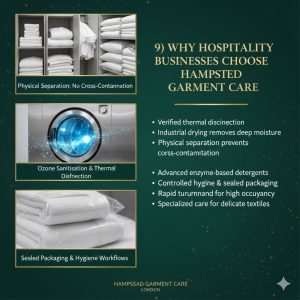 Our commercial laundry system offers advantages that far exceed the capabilities of domestic appliances:
-
Verified thermal disinfection combined with ozone sanitisation
-
Industrial drying that removes residual moisture at the fibre core
-
Physical separation of towels, robes, and bed linen to prevent cross-contamination
-
Advanced enzyme-based detergents engineered for high soil loads
-
Controlled hygiene workflows and sealed, contamination-free packaging
-
Rapid turnaround to support high occupancy and same‑day guest changeovers
-
Specialised care protocols for Egyptian cotton, bamboo, modal, and microfibre
We do not simply wash Linen — we restore fibre structure, protect textile investment, and enhance guest comfort in every item we process.
10) Conclusion — Laundry Hygiene as a Core Operational Standard in 2025
 In contemporary hospitality, linen hygiene is no longer a routine housekeeping task. It has evolved into a core operational standard that shapes guest trust, brand credibility, and revenue generation. Textiles serve as a direct sensory interface between guests and the property; therefore, their quality profoundly influences perceptions of cleanliness and attention to detail.
Facilities that fail to prioritise professional laundry hygiene often encounter:
-
Lower review scores and reduced platform visibility
-
Increased frequency of complaints about odour, irritation, or perceived neglect
-
Decreased return visits and shortened stays
-
Escalating linen replacement costs due to fibre fatigue and premature wear
In contrast, businesses that partner with professional laundry providers consistently achieve:
-
Fresher, softer, clinically sanitised Linen
-
Higher guest satisfaction and improved cleanliness ratings
-
Stronger occupancy stability and repeat bookings
-
Lower long-term textile expenditure and enhanced asset longevity
Laundry hygiene is a measurable determinant of operational success — and in 2025, it serves as a competitive advantage for any hospitality business committed to excellence.
Upgrade Your Hospitality Laundry Hygiene Today
Hotels, Airbnb hosts, spas, gyms, and medical clinics across London trust Hampstead Garment Care for science-based, hygiene-focused, professionally managed laundry solutions.
Book your collection today and experience a new standard of cleanliness, textile care, and guest satisfaction.



No comment