
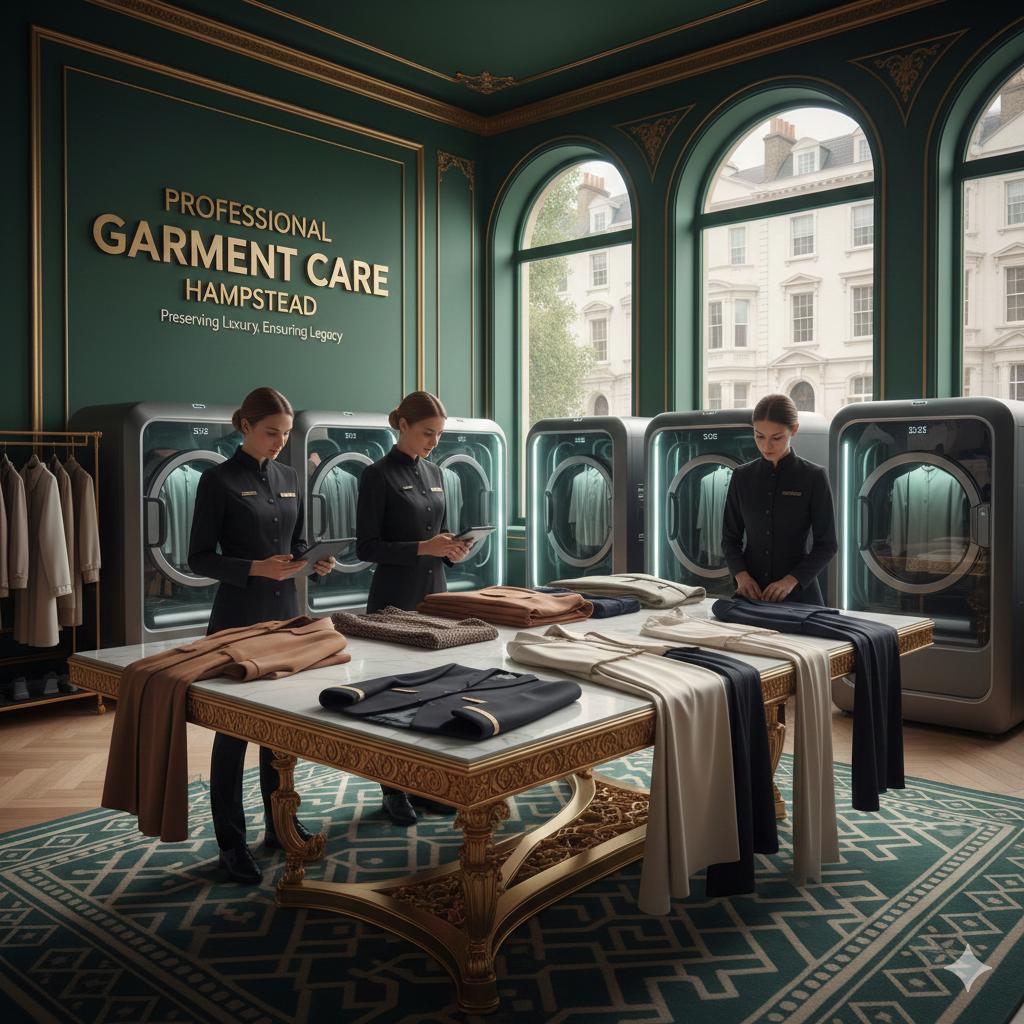
Professional Garment Care Hampstead: A Systematic Approach to Preserving Luxury Clothing
Professional Garment Care Hampstead begins with the understanding that clothing in Hampstead is typically acquired with longevity in mind. Garments are selected for material quality, construction integrity, and aesthetic endurance rather than short-term trends. As a result, many wardrobes feature tailored jackets, cashmere knitwear, silk garments, structured coats, and other high-value pieces designed to withstand extended wear.
Despite this, premature garment degradation is common. In most cases, this deterioration is not caused by excessive wear or age, but by inappropriate cleaning methods.
Professional garment care in Hampstead extends beyond superficial cleanliness. Its primary objective is the long-term preservation of textile structure, fibre integrity, colour stability, and garment fit. When garments are exposed to unsuitable domestic laundering or non-specialised dry-cleaning processes, damage accumulates incrementally and is frequently irreversible.
This article examines Professional Garment Care Hampstead from a technical and material-science perspective, explaining why it is essential for luxury clothing and why standardised cleaning methods often undermine garment lifespan.
Defining Professional Garment Care Hampstead
 Professional garment care is a fabric-centred, analytical process grounded in informed decision-making. It draws on principles from textile science, garment engineering, and material preservation rather than relying solely on appearance-based outcomes.
Unlike conventional dry cleaning, which relies on standardised cycles optimised for speed, throughput, and operational efficiency, professional garment care evaluates each garment individually prior to treatment. This evaluation serves as a diagnostic stage, akin to a material assessment, and is designed to identify how a garment will respond to cleaning stresses before any intervention.
During this assessment, trained specialists systematically analyse:
-
Fibre composition, including whether fibres are natural, synthetic, or blended, as this determines moisture tolerance, solvent interaction, elasticity, and long-term fatigue behaviour
-
Fabric construction, such as weave type, knit structure, density, and surface finish, all of which influence abrasion resistance, drape retention, and dimensional stability
-
Dye chemistry, including colour saturation and fixation method, to assess the risk of fading, bleeding, or tonal distortion during cleaning
-
Mechanical stress distribution, identifying high-wear zones such as collars, cuffs, seams, and load-bearing areas that require reduced agitation or targeted treatment
-
Internal structural components, including canvassing, interfacing, padding, and seam architecture, which are particularly vulnerable to moisture imbalance and heat exposure
Based on this diagnostic profile, a garment-specific cleaning strategy is developed. This may involve selecting milder or alternative solvents, limiting solvent exposure time, introducing controlled moisture rather than full saturation, reducing mechanical agitation, or modifying pressing and finishing parameters to align with the garment’s internal structure.
In this context, the objective of professional garment care is not simply cleanliness in the immediate sense. Instead, it is the management of material degradation over time—often referred to as controlled ageing—that preserves fibre strength, surface texture, colour integrity, and structural performance, ensuring garments maintain their functional and aesthetic properties across repeated wear and care cycles.
Material and Structural Sensitivity of Luxury Clothing in Professional Garment Care, Hampstead
Luxury garments are engineered systems rather than simple fabric assemblies. Their performance depends on the controlled interaction between fibres, yarns, fabric construction, and internal structural elements, all of which are designed to work together under specific mechanical and environmental conditions.
Unlike mass-produced garments, luxury clothing is often crafted with a strict attention to detail. Precision in fibre selection, yarn preparation, and assembly allows for superior drape, comfort, and aesthetic refinement, but it also reduces the margin for aggressive cleaning methods.
They are characterised by:
-
Natural fibres with complex molecular and structural properties, such as wool, cashmere, and silk, which rely on internal protein structures and moisture balance to maintain elasticity, softness, and strength
-
Fine yarn twists and low-twist constructions that enhance drape and surface smoothness but are more susceptible to fibre slippage, distortion, and breakage under mechanical stress
-
Advanced dyeing processes that prioritise colour depth, tonal complexity, and visual nuance rather than chemical robustness, making them more vulnerable to solvent exposure and thermal fluctuation
-
Internal structural elements, including canvassing, interfacing, padding, and layered seam construction, which distribute load and define garment shape but respond unevenly to moisture, heat, and pressure
These characteristics collectively increase sensitivity to water, heat, friction, and chemical exposure. When luxury garments are subjected to aggressive laundering or generic dry-cleaning cycles, the cleaning process disrupts the equilibrium between fibre, dye, and structure.
At the fibre level, repeated mechanical and chemical stress accelerates fatigue, reducing elasticity and tensile strength. At the dye level, molecular bonds weaken, leading to fading, bleeding, or uneven tonal shifts. At the structural level, differential shrinkage and moisture imbalance cause internal components to lose alignment, resulting in distortion and loss of shape.
Over repeated cleaning cycles, these effects compound. What begins as microscopic fibre damage and subtle colour change eventually manifests as visible deterioration, reduced comfort, and irreversible structural failure.
Typical Damage Resulting from Inappropriate Cleaning
 Inappropriate cleaning methods introduce stresses that exceed what luxury materials and garment constructions are designed to tolerate. The resulting damage often begins at a microscopic level and progresses gradually, which is why it is frequently underestimated until it becomes visually obvious.
-
Loss of loft, softness, and recovery in cashmere and wool
Protein-based fibres such as wool and cashmere rely on a delicate balance of natural oils, fibre crimp, and moisture content to maintain elasticity and volume. Excessive agitation, heat, or harsh chemicals strip these oils and relax the fibre structure, leading to fibre collapse. Over time, garments lose their ability to spring back after wear, resulting in flatness, stiffness, and a noticeably shorter usable life. -
Diminished lustre and altered hand-feel in silk
Silk fibres have a smooth, triangular structure that reflects light, producing a natural sheen. Exposure to aggressive solvents, alkalinity, or mechanical friction disrupts the fibre surface, leading to uneven light scattering. This leads to a dull appearance and a dry or brittle hand-feel that cannot be restored once the fibre surface has been damaged. -
Dimensional instability in tailored garments, including shrinkage and torsion
Tailored garments contain multiple layers—outer fabric, interfacing, canvassing, and lining—that often respond differently to moisture and heat. When these layers are exposed to uncontrolled cleaning conditions, differential shrinkage occurs. This causes twisting (torsion), puckering, or imbalance in the garment, particularly around lapels, sleeves, and seams, permanently altering fit and drape. -
Chromatic degradation, such as fading, bleeding, or uneven tonal shifts
Luxury dyes are often chosen for depth and nuance rather than for chemical resistance. Repeated exposure to unsuitable solvents, high temperatures, or prolonged moisture weakens dye-fibre bonds. As a result, colours fade prematurely, bleed into adjacent areas, or develop uneven patches that cannot be corrected through finishing. -
Progressive seam stress and internal structural failure
Seams and internal structures concentrate mechanical load during wear and cleaning. Aggressive cycles accelerate thread fatigue and weaken stitch integrity, while moisture imbalance affects interlinings and padding. Over time, this leads to seam slippage, bubbling, or collapse of internal structure, even when the outer fabric appears intact.
These forms of damage are cumulative and largely irreversible. While surface pressing or reshaping may temporarily conceal defects, the underlying fibre and structural degradation remain. Once material integrity has been compromised, no finishing process can fully restore the garment to its original performance or longevity.
Constraints of Standard Dry-Cleaning Systems vs Professional Garment Care Hampstead
 Standard dry-cleaning systems are engineered primarily for consistency, speed, and throughput rather than material-specific preservation. Their design reflects the operational needs of volume-based cleaning environments, where efficiency and visual uniformity take precedence over garment-level optimisation.
Traditional dry cleaning prioritises immediately observable outcomes, including:
-
Stain reduction
-
Odour removal
-
Immediate wearability achieved through pressing and reshaping
While these outcomes satisfy short-term consumer expectations, they provide limited insight into what is occurring at the fibre and structural levels of the garment.
Most standard dry-cleaning operations rely on a narrow range of solvents and uniform process parameters—fixed cycle durations, consistent mechanical agitation, and standardised finishing protocols—applied across a wide variety of garments. This lack of differentiation introduces several preservation risks.
At the fibre level, repeated exposure to non-specific solvents gradually extracts essential natural oils, particularly in protein-based fibres such as wool and cashmere. These oils play a critical role in maintaining fibre flexibility, resilience, and resistance to breakage. Their removal leads to increased brittleness, reduced elasticity, and accelerated fibre fatigue.
At the fabric surface level, mechanical action and solvent interaction compress fibre ends and disrupt surface topology. Over time, this flattens fabric texture, diminishes tactile quality, and alters light reflection, causing garments to appear lifeless despite being technically clean.
At the structural level, uniform processing fails to account for differences in fabric weight, construction, and internal architecture. Repeated cycles with fixed agitation and drying parameters place cumulative stress on seams, interlinings, and load-bearing areas. This progressively reduces tensile strength and compromises the garment’s ability to maintain shape under wear.
The combined effect of these processes is a measurable reduction in garment service life. Although deterioration may not be immediately visible, each standardised cleaning cycle incrementally lowers the garment’s mechanical and aesthetic performance.
While such outcomes may be acceptable for low-value, utilitarian, or short-lifespan clothing, they are fundamentally incompatible with the preservation requirements of luxury garments, which are designed for longevity, refinement, and structural integrity.
Professional garment care in Hampstead directly addresses these constraints by replacing uniform processing with fabric-specific decision-making. By prioritising material stability, controlled stress exposure, and long-term performance, professional garment care shifts the focus from short-term visual results to sustainable garment preservation.
Technical Implications of Home Laundering vs Professional Garment Care in Hampstead
 Although domestic laundering appears cost-effective, it introduces multiple stressors that luxury garments are not engineered to withstand. Home washing systems are designed for general household textiles—such as cotton basics and synthetics—not for garments constructed from fine natural fibres, complex weaves, or layered internal structures.
From a technical perspective, domestic laundering exposes garments to uncontrolled mechanical, chemical, and environmental variables. Unlike professional garment care, these variables cannot be precisely adjusted to account for fibre type, fabric construction, or structural complexity, leading to cumulative material degradation.
Mechanical Stress
Modern washing machines rely on rotational agitation and high-speed spin cycles to remove soil and extract water efficiently. While effective for robust fabrics, these movements impose torsional (twisting) and tensile (stretching) forces that routinely exceed the elastic recovery limits of fine fibres such as wool, cashmere, silk, and viscose.
During repeated wash cycles, fibres are forced to elongate and recoil beyond their natural capacity. This accelerates fibre fatigue, weakens internal bonding, and reduces the material’s ability to recover its original shape. In tailored or structured garments, this stress is unevenly distributed, concentrating damage at seams, edges, and load-bearing areas.
Chemical Stress
Household detergents are formulated to maximise soil and oil removal across a wide range of fabrics. To achieve this, they typically operate at higher alkalinity levels and contain aggressive surfactants, enzymes, and optical brighteners.
While effective at cleaning, these formulations are chemically incompatible with many luxury fibres. Protein-based fibres are particularly vulnerable to alkaline environments, which disrupt hydrogen bonding and accelerate molecular breakdown. Over time, repeated chemical exposure strips protective surface layers, reduces fibre cohesion, and increases susceptibility to breakage and surface abrasion.
Water and Thermal Stress
Domestic laundering introduces significant variability in water quality and temperature. Hard water minerals interfere with detergent performance and deposit residues within fibres, increasing stiffness and reducing softness. Temperature fluctuations during washing and drying further exacerbate fibre contraction and expansion cycles.
Uncontrolled tumble drying compounds these effects. Rapid moisture removal and elevated heat levels cause uneven shrinkage, distort fabric geometry, and intensify long-term fatigue. In multi-layer garments, differential response between outer fabrics and internal components leads to progressive misalignment and loss of structural integrity.
Cumulative Economic Impact
Individually, each laundering cycle may appear harmless. However, from a lifecycle perspective, the cumulative effects of mechanical, chemical, and thermal stress significantly shorten garment lifespans. As luxury garments degrade prematurely, the financial cost of repair or replacement consistently exceeds the cumulative cost of professional garment care designed to manage these stresses in a controlled, material-appropriate manner.
Comparative Overview: Regular Dry Cleaning vs Professional Garment Care
| Parameter | Regular Dry Cleaning | Professional Garment Care |
|---|---|---|
| Process design | Standardised | Fabric-specific |
| Garment handling | Volume-oriented | Individualised |
| Primary objective | Visual cleanliness | Material preservation |
| Damage risk | Elevated | Minimal |
| Expected garment lifespan | Reduced | Extended |
This distinction directly influences whether garments retain performance over years rather than seasons.
Professional Garment Care Hampstead: Service Scope
 Hampstead Garment Care delivers professional garment care services across Hampstead, Finchley Road, and North London, supporting clients whose wardrobes are built around high-value, structurally complex garments. The service model is designed to prioritise material preservation, risk reduction, and long-term garment performance rather than volume-based throughput.
Service coverage includes:
-
Hampstead
-
Finchley Road
-
North London
Each service category operates within a controlled workflow that begins with garment assessment and ends with construction-aware finishing, ensuring continuity of care throughout handling.
Core Service Areas
-
Luxury dry cleaning with fabric-specific protocols
Cleaning methods are selected based on fibre chemistry, fabric structure, dye stability, and garment construction. Solvent choice, exposure duration, agitation intensity, and moisture control are adjusted garment by garment to minimise fibre fatigue and structural stress. -
Specialist textile and surface treatments
Targeted treatments address fibre-specific issues such as oil depletion, surface roughening, and localised wear. These interventions are designed to stabilise material conditions rather than mask deterioration. -
Advanced stain analysis and removal
Stain treatment begins with chemical identification and substrate evaluation. This reduces the risk of dye disruption, fibre damage, or stain setting that commonly occurs when removal methods are applied without diagnostic analysis. -
Precision pressing aligned with garment construction
Finishing is carried out in accordance with the internal architecture, including seam placement, canvassing, and interfacing. Pressing parameters such as temperature, steam volume, and pressure distribution are calibrated to restore shape without inducing compression or distortion. -
Shoe, accessory, and delicate item care
Non-garment items are treated using material-appropriate processes that account for leather structure, surface coatings, adhesives, and composite materials, reducing degradation caused by generic cleaning methods.
Across all services, garments are handled as long-term material and financial assets. Processing decisions are guided by preservation outcomes rather than speed, ensuring that repeated care cycles support longevity, performance, and aesthetic stability rather than gradual degradation.
Treating Clothing as a Long-Term Asset
 Luxury garments should be understood as long-term material assets rather than disposable consumer goods. Their value lies not only in brand or appearance, but also in the quality of the fibres, the precision of construction, and the cumulative labour embedded in their design and manufacture. As with any high-value asset, longevity depends on how consistently stress is managed over time.
Generic cleaning systems are fundamentally misaligned with this objective. They apply uniform processes that prioritise short-term visual cleanliness while ignoring lifecycle performance. For luxury garments, this approach accelerates depreciation by increasing fibre fatigue, destabilising dyes, and weakening internal structure with each cleaning cycle.
From a textile science perspective, proper maintenance serves as risk management. Controlled environments, calibrated process parameters, and informed decision-making reduce exposure to mechanical, chemical, and thermal stress. This allows garments to retain structural integrity, chromatic stability, and functional performance across repeated wear and care cycles.
At Hampstead Garment Care, the objective is not simply to return garments in a wearable state, but to actively manage their ageing. By aligning cleaning methods with fibre behaviour and garment construction, we extend usable lifespan, delay irreversible degradation, and preserve both aesthetic and economic value.
This approach transforms garment care from a routine service into a strategic intervention—one that protects investment, reduces replacement costs, and ensures that high-quality clothing continues to perform as intended.
📍 Serving Hampstead & North London
📦 In-store and collection services available
💬 WhatsApp consultation available
👉 Book Your Professional Garment Care Service Today
Conclusion
 Professional garment care should not be viewed as a discretionary luxury or an aesthetic indulgence. From a technical and economic standpoint, it represents a rational, evidence-based approach to maintaining high-value clothing over its intended lifespan.
Luxury garments are designed with specific material properties, structural tolerances, and performance expectations. When cleaning methodologies fail to align with these parameters, degradation is not accidental but inevitable. Each inappropriate cleaning cycle introduces avoidable mechanical, chemical, or thermal stress that incrementally reduces fibre strength, destabilises dyes, and compromises internal structure.
For wardrobes built on quality and longevity, cleaning methodology is a critical control variable throughout the garment lifecycle. It directly influences cost-per-wear, replacement frequency, and long-term performance. Treating garment care as an afterthought effectively accelerates depreciation, transforming durable, well-constructed clothing into prematurely worn items.
By contrast, professional garment care applies controlled processes, informed assessment, and material-specific decision-making to manage ageing rather than accelerate it. This approach preserves functional integrity, aesthetic consistency, and economic value over time.
In practical terms, professional garment care is not about doing more—it is about doing less damage. For individuals who invest in quality clothing, it is the most effective strategy to ensure those garments continue to perform, fit, and age as their designers intended.
Professional Garment Care Hampstead begins with the understanding that clothing in Hampstead is typically acquired with longevity in mind. Garments are selected for material quality, construction integrity, and aesthetic endurance rather than short-term trends. As a result, many wardrobes feature tailored jackets, cashmere knitwear, silk garments, structured coats, and other high-value pieces designed to withstand extended wear.
Despite this, premature garment degradation is common. In most cases, this deterioration is not caused by excessive wear or age, but by inappropriate cleaning methods.
Professional garment care in Hampstead extends beyond superficial cleanliness. Its primary objective is the long-term preservation of textile structure, fibre integrity, colour stability, and garment fit. When garments are exposed to unsuitable domestic laundering or non-specialised dry-cleaning processes, damage accumulates incrementally and is frequently irreversible.
This article examines Professional Garment Care Hampstead from a technical and material-science perspective, explaining why it is essential for luxury clothing and why standardised cleaning methods often undermine garment lifespan.


No comment